The spectrum of light extends far beyond the visible.
Cell phones and Wi-Fi use microwaves to transmit digital information.
CT scans use x-rays to look inside a person's body.
Thermometers detect infrared light to read temperature.
Fundamentally all of these waves are produced the same way.
When a charged particle accelerates, its electric field and magnetic field change.
This change propagates as a wave in the electro-magnetic field. The wave is light.
Changes in an electric and magnetic field don't happen immediately. It takes time for changes in an
electromagnetic field to propagate through space.
The speed of these changes to the E-M field is the speed of light.
In this simulation a charged particle follows your mouse.
The white lines show the electric field from a charged particle.
The ripples in the field lines are light.
Well, at least the electric part, there is also a magnetic field perpendicular to the electric that I left out.
A quick acceleration makes high frequency light. Slow acceleration makes low frequency light.
You can't quite make a "sonic boom" with light because a charged particle can't move faster than the speed that light waves propagate.
The Speed of Light
In 1676 Ole Rømer estimated that light has a speed by timing the eclipses of Io, one of Jupiter's moons.
He found the speed to be around 220 000 000 m/s.
This isn't too far from the value we use today.
We can use the speed of light as the velocity in the wave equation.
\(c\) = speed of light [m/s]
\(f\) = frequency [Hz, 1/s]
\(\lambda\) = wavelength [m]
The speed of light in a vacuum is the fastest possible speed! No object has ever been recorded moving faster.
As objects approach the speed of light their time dilates and length contracts.
A light wave moves slower in dense media because light induces electric polarization in matter,
and the polarized matter radiates new light that interferes with the original light wave to form a delayed wave.
speed of light
vacuum
air
water
diamond
(m/s)
299 792 458
299 700 000
225 000 000
120 000 000
When we say "the speed of light" we generally mean the vacuum speed.
Example: Find the wavelength of an electromagnetic wave that has a frequency of
109 Hz.
solution
Example: The Sun is 1.50 × 10⁸ km from Earth. How long does it take for the light
from the Sun to reach us?
solution
$$v = \frac{\Delta x}{\Delta t} $$
$$\Delta t = \frac{\Delta x}{v} $$
$$\Delta t = \frac{1.50 \times 10^{8}\times10^{3}\,\mathrm{m}}{3.0 \times 10^{8}\,\mathrm{\frac{m}{s}}} $$
$$\Delta t = 500\, \mathrm{s} $$
$$\Delta t = 8.33 \, \mathrm{min} $$
Example: The center of the Earth is 384 400 km from the center of the Moon. What is the
shortest amount of time it takes light to travel from the Moon to the Earth?
Local Massive Objects Data Table
Planet
mass (kg)
radius (km)
Sun
2.00 × 1030
695 700
Mercury
3.301 × 10²³
2440
Venus
4.867 × 1024
6052
Earth
5.972 × 1024
6371
Moon
7.346 × 10²²
1737
Mars
6.417 × 10²³
3390
Jupiter
1.899 × 1027
70 000
Saturn
5.685 × 1026
58 232
Uranus
8.68 × 1025
25 362
Neptune
1.024 × 1026
24 622
solution
$$\Delta x = 384\,400\,\mathrm{km} - 6371\,\mathrm{km} -1737\,\mathrm{km} = 376\,000\,\mathrm{km}$$
$$v = \frac{\Delta x}{\Delta t} $$
$$\Delta t = \frac{\Delta x}{v} $$
$$\Delta t = \frac{3.76 \times 10^8 \,\mathrm{m}}{3.0 \times 10^8\,\mathrm{\frac{m}{s}}} $$
$$\Delta t = 1.25\, \mathrm{s} $$
A light-year [ly] is a unit of distance. A light year is the distance that light travels
in one year. It is mostly used to measure distances to objects outside the solar system.
Example: How far is one light year in meters?
strategy
$$v = \frac{\Delta x}{\Delta t} $$
The velocity is the speed of light. The time is 1 year. Be sure to convert units.
Example:Alpha Centauri is the nearest star system to ours.
It is 4.37 light-years away.
How far away in meters is Alpha Centauri?
solution
$$\Delta x = 4.37 \, \mathrm{ly} \left( \frac{9.46 \times 10^{15} \, \mathrm{m}}{1 \, \mathrm{ly}}
\right)$$
$$\Delta x = 4.134 \times 10^{16}\, \mathrm{m}$$
The Electromagnetic Spectrum
Light can be viewed as a spectrum.
The lowest energy, lowest frequency, and longest wavelength are on one end.
The highest energy, highest frequency, and shortest wavelength are on the other.
The electromagnetic spectrum is very loosely divided in these regions based on the source of that
light.
Microwave and radio waves are produced by changing electric current.
Infrared light is mostly produced by the thermal radiation of bodies at room temperature.
Visible light comes from thermal radiation (sunlight), chemical reactions (fire), and numerous technologies
(LED, laser, cathode ray tube, gas discharge lamps).
Ultraviolet light comes from the same sources as visible light, but at a slightly higher frequency that
humans can't see.
X-rays can be produced by accelerating electrons very quickly, like in cathode ray vacuum tubes.
Gamma rays are similar to X-rays, but they are generally distinguished by coming from radioactive decay
instead of electron acceleration.
Question: Hydrogen is the most common element in the universe, making up about 75% of all
normal mass. It floods the universe with light at its signature wavelength of
21 cm. What region of the electromagnetic spectrum
would this light be in?
answer
$$21\, \mathrm{cm} \left(\frac{0.01}{c}\right) = 0.21\, \mathrm{m}$$
$$\text{ 0.21 m is in the microwave}$$
Question: In human skin, vitamin D production occurs when a precursor molecule reacts with
light at wavelengths between 270 and 300 nm. What range of the E-M spectrum includes that wavelength?
answer
Question: What color in the visible spectrum has the longest wavelength
answer
Red has the longest wavelength.
Light slows down in denser media, which causes it to refract.
Refraction causes the various frequencies that make up white light to disperse because each
frequency slows to a different speed.
Question: Use the image to decide what color moves the slowest in glass.
answer
Blue / violet light refracts at
the most extreme angle.
This means that as light passes through glass, blue slows down the most and red the least.
Question: The color of an object is determined by the wavelength of light it reflects.
Which color of visible light has the shortest wavelength?
answer
Violet has the shortest wavelength in the visible spectrum. It has a wavelength of around 380-450
nm.
Color Vision
Our eyes have two types of cells that respond to visible light, rods and cones.
Rods detect visible light with a high sensitivity.
Cones specialize in detecting the wavelength of the light.
Cone cells come in different types that are sensitive to different wavelengths of visible light.
The number of colors receptors has varied as life has evolved. Most birds and reptiles have 4 different
color receptors.
Mammals have 2 color vision, with the exception of primates that have 3
color vision.
Humans are primates, so we mostly have 3 different color receptors, but some color blind humans have 2.
They don't see in black and white, they just have trouble telling the difference between some colors, like
red and green.
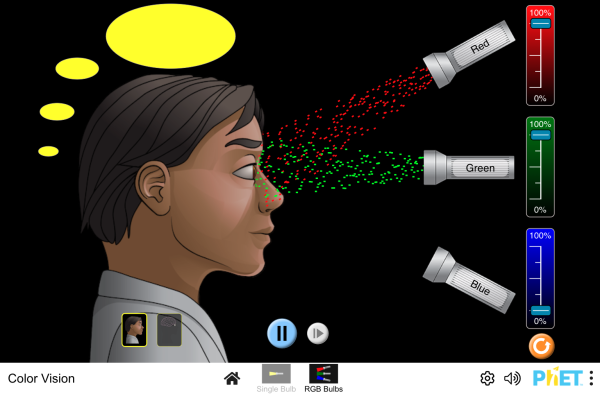
Human cones cells respond to 3 overlapping regions on the electromagnetic spectrum.
We can see every color on the rainbow from this
information.
What about colors not on the rainbow?
If multiple cones are activated our brains invent colors to describe the experience, like pink or white.
Click to Run
Information from our eyes is processed in our
brains to build a guess about what we are seeing.
Our brain's interpretation isn't perfect. We call these mistakes opticalillusions.
Question: Why do you think we see mostly in black and white when it's dark?
answer
We have 2 types of cells that detect light.
Cones specialize in detecting the wavelength of the light, but they aren't very sensitive to low light conditions.
Rods can't see color, but they are very sensitive, so they contribute more when it's dark.
One source of confusion comes from similar terms for subtractive and additive colors. Light sources work
by adding color.
Adding more colors of light will bring the color we see closer to white.
This is how computer screens produce a wide gamut of color.
green light +
blue light appear
cyan red light +
blue light appear
magenta red light +
green light appear
yellow red light
+
green light +
blue light appear
white
Pigments, paints, dyes, and filters work by subtracting color. When white light shines on
blue
paint it looks blue because the blue pigment absorbs every color except blue. Adding more pigments will
remove more color and bring the reflected light closer to black, the absence of light.
magenta dye +
yellow dye reflect only
red light cyan dye +
yellow dye reflect only
green light cyan dye +
magenta dye reflect only
blue light cyan dye
+
magenta dye +
yellow dye
reflect
no light
Question: What three colors of light does a TV need to make every color that humans can
experience.
answer
Most televisions can only produce red, green, and blue light. They get the other colors from
different ratios of red, green, and blue.
Question: What three pigments does a printer need to make every color that humans can
experience.
answer
Most printers use a combination of cyan, magenta, yellow, and black.
light
Red
Green
Blue
filter
Cyan
Red
Magenta
Green
Yellow
Blue
Question: What combination of light sources make the color pink?
answer
red = 1.0
green = 0.4
blue = 0.7
Question: What combination of light sources make the color brown?
answer
Brown is tricky. Brown is dark orange, in the same way that grey is dark white.
Orange is red plus a bit of green, and almost no blue.
Making orange look dark depends on context.
Dark orange only looks dark with a bright background.
If you aren't convinced try this:
Make your surroundings completely dark.
(it will only work if the room you are in is super dark)
Click on the brown square to darken the background color of this page.
Wait at least ten seconds for your eyes to adjust.
Look at the brown box again.
Question: A green filter removes red and blue light to leave just green light.
How else could filters turn white light into green light?
answer
Green light can be produced by filtering Cyan and Yellow light.
Question: What type of light makes the color black?
answer
the absence of light
Polarization
Polarization is a property of transverse waves that describes the angle of oscillation. The
polarization can be any angle perpendicular to the direction the wave is moving.
Most light sources are unpolarized. They oscillate a bit in every direction. Light can become polarized
after passing through a polarization filter that only removes the light that oscillates at a certain angle.
A polarization filter that blocks vertical light
will let horizontally polarized light through. Polarization filters are often used in sunglasses or 3-D
movies.
Unpolarized light can also become partially polarized after reflecting off some shiny surfaces. The
reflected light becomes polarized parallel to the surface. For example, a flat road reflects horizontally
polarized light.
Question: What polarization does the Sun produce?
answer
Most light sources, including the Sun, don't produce one polarization. They produce light with
random polarizations.
Although, the refracted blue sunlight from Rayleigh
scattering is polarized towards the Sun.
Question: What classifications of waves can and can't be polarized?
answer
Transverse wave, like light, can be polarized.
Longitudinal waves, like sound, can't be polarized.
(except for sound waves in solids, which can be transverse)
Question: What angle would a polarization filter need to be to block the glare from a
highway road?
answer
A horizontal polarization filter will block the glare from a road.
Question: Imagine looking at sunlight through a horizontal polarization filter and a
vertical polarization filter. What color would you see?
answer
It would just be black, since all the light would be blocked.
If you put a filter at 45° between a horizontal and vertical polarization filter it isn't black due to a fascinating,
but complex, quantum mechanical interactions.
Thermal Radiation
The particles in all substances move and vibrate in a seemingly random way.
Temperature is a measure of the average kinetic energy of these particles.
When the temperature is high there is more motion.
When charged particles accelerate they produce light.
This means that as substances get hotter they make brighter and higher frequency light.
Click to Run
All matter gives off light due to its temperature.
Objects at room temperature give off infrared light which humans can't see.
The wavelengths given off by thermal radiation reflect the range of particle speeds.
Because the speeds are unevenly distributed the light produced has a sharp drop off at shorter wavelengths and a long tail for longer wavelengths.
The Kelvin scale is normally used to describe thermal color temperatures.
It's common to see in lighting and photography.
The lowest temperature humans can see is around 798K.
Daylight is around 5500K-6500K depending on clouds.
Most people prefer indoor lighting at a lower temperature, maybe 4500K.
Example: The Sun's surface temperature is approximately 5778 Kelvin (K).
Convert this temperature to Celsius (°C) and Fahrenheit (°F).
$$C = K - 273.15 \quad \quad \quad F = \frac{9}{5}C+32$$
answer
Question: Could a substance at room temperature emit a UV ray from thermal emission?
answer
Yep, but it would be rare.
Question: You see several substances glowing from thermal emission. What color do you
suspect is the highest temperature?
(red, yellow, white, black, pink, green, orange, blue)
answer
hottest to coldest:
blue, white, yellow, orange, red, black
(pink and green are not possible thermal emission colors)
Question: Why is fire blue on the
stove, but normally yellow?
answer
Only a small part of a flame's color comes from thermal radiation.
A flame has a temperature around 1200° C, which would only appear dark red from thermal emission.
Most of a flame's light is released when electrons rearrange during chemical reactions.
The blue light in a flame comes from oxygen chemically reacting with a fuel source.
When fire doesn't have enough oxygen, extra carbon atoms are produced.
These carbon atoms group up into large "soot" particles.
The soot releases yellow light as the carbon breaks and reforms bonds.
Unusual colors like green come from adding impurities to the fire.
For example, when copper is added to fire it releases green light in a process called line emission
practice problems (21)
In case you wanted more practice I used AI to make some more problems. The rest of the site I made by hand, but generating endless problems seemed safe. I did find mistakes in the AI generated problems, and there are probably some I didn't find. Let me know if something could be fixed. I also added a practice problem on each page with no solution. That's intentional. Have fun!
Question: A charged particle in an antenna is forced to accelerate back and forth. Why can that produce radio light even though no visible glow is seen?
answer
Accelerating charge changes the electric and magnetic fields around it. That changing electromagnetic field propagates outward as light.
Radio waves are light, but their frequency is much lower and their wavelength is much longer than visible light, so our eyes cannot see them.
Example: A Wi-Fi router uses light with frequency 2.4 × 10⁹ Hz. The signal carries data through walls and across a room, even though your eyes cannot detect it. What is the wavelength of this microwave signal in air? Use 3.00 × 10⁸ m/s for the speed of light.
solution
Example: A red laser pointer has wavelength 650 nm. It is useful in a classroom because the light is concentrated and easy for human cone cells to detect. What is the frequency of the red light?
solution
Question: Put these spectrum regions in order from lowest frequency to highest frequency: x-ray, infrared, visible, radio, ultraviolet, microwave, gamma ray.
answer
From lowest frequency to highest frequency:
radio, microwave, infrared, visible, ultraviolet, x-ray, gamma ray
Lowest frequency also means longest wavelength. Highest frequency means shortest wavelength.
Example: An airport radar system uses electromagnetic waves with wavelength 3.0 cm. The beam sweeps across the sky many times per minute, but the wave itself moves at light speed. What is the frequency of the radar wave?
solution
The frequency is 1.0 × 10¹⁰ Hz, which is in the microwave range.
Example: Some vitamin D chemistry in skin is triggered by ultraviolet light with wavelength around 290 nm. What is the frequency of this ultraviolet light?
solution
Example: When Mars is at an average distance from Earth, it is about 2.25 × 10¹¹ m away. How long does a radio command from Earth take to reach a rover on Mars?
solution
$$v = \frac{\Delta x}{\Delta t}$$
$$\Delta t = \frac{\Delta x}{c}$$
$$\Delta t = \frac{2.25 \times 10^{11}}{3.00 \times 10^{8}}$$
$$\Delta t = 750\,\mathrm{s}$$
$$750\,\textcolor{DeepPink}{\mathrm{s}}\left(\frac{1\,\mathrm{min}}{60\,\textcolor{DeepPink}{\mathrm{s}}}\right)$$
$$12.5\,\mathrm{min}$$
A rover driver can't steer in real time. A reply takes at least 25 minutes to come back, so rovers are programmed to drive themselves.
Example: The Voyager 1 space probe is about 2.5 × 10¹³ m from Earth. How long does a radio signal from Voyager take to reach us, in hours?
solution
$$\Delta t = \frac{\Delta x}{c}$$
$$\Delta t = \frac{2.5 \times 10^{13}}{3.00 \times 10^{8}}$$
$$\Delta t = 8.3 \times 10^{4}\,\mathrm{s}$$
$$8.3 \times 10^{4}\,\textcolor{DeepPink}{\mathrm{s}}\left(\frac{1\,\mathrm{h}}{3600\,\textcolor{DeepPink}{\mathrm{s}}}\right)$$
$$23\,\mathrm{h}$$
Radio waves are light, so they travel at c. Even at light speed, a message takes almost a full day each way.
Question: The page says light moves slower in dense media. What is happening to the light inside matter that makes the wave delayed?
answer
The light interacts with matter by inducing electric polarization. The polarized matter radiates new light.
That new light interferes with the original light wave in a way that produces a delayed wave. The result is a lower light speed in the medium.
Example: A tiny sparkle travels through a 2.0 mm thick diamond chip. Use 1.20 × 10⁸ m/s for the speed of light in diamond. How long does the light take to cross the diamond?
solution
Example: Green light has frequency 5.0 × 10¹⁴ Hz. In water, light travels at about 2.25 × 10⁸ m/s. What is the wavelength of this green light in water?
solution
Use the light speed in water, not the vacuum speed.
Question: A phone screen makes yellow by turning on red and green light in the same small pixel. Is this additive color or subtractive color, and why?
answer
This is additive color.
A screen makes color by adding light sources. Red light plus green light is interpreted by our visual system as yellow.
Question: A printer puts cyan and yellow ink on white paper to make green. Is this additive color or subtractive color, and what colors are being removed?
answer
This is subtractive color.
Cyan dye removes red light. Yellow dye removes blue light. The light left to reflect is mostly green, so the paper looks green.
Question: A pair of polarized sunglasses reduces glare from sunlight reflecting off a lake. What does the filter do to the light wave, and why is polarization a property of transverse waves?
answer
A polarization filter only lets through light oscillating in one direction. Glare from a flat surface is often strongly polarized, so the sunglasses can block much of that reflected light.
Polarization describes the direction of oscillation. That only makes sense for transverse waves because their oscillation is perpendicular to the direction the wave travels.
Example: A green beam with a wavelength of 530 nm hits the flat face of a glass prism at 35° from the normal. The prism is 4.0 cm thick. What angle does the beam make with the normal inside the glass?
solution
This cannot be solved from the information given. Snell's law from the waves page would find the angle, but it needs the glass's index of refraction, and that is missing.
The wavelength and thickness don't replace the index. Different kinds of glass bend light by different amounts.
Example: A tungsten filament in an old incandescent bulb is about 3000 K when glowing. Convert this temperature to Celsius and Fahrenheit.
solution
Question: Objects at room temperature give off light, but people do not usually glow visibly in a dark room. What kind of light are they mostly emitting?
answer
They are mostly emitting infrared light.
All matter gives off thermal radiation, but room-temperature objects mostly emit wavelengths too long for human eyes to detect.
Example: Lava from a volcano is about 1200°C when it flows. What is that temperature in kelvin?
solution
$$C = K - 273.15$$
$$K = C + 273.15$$
$$K = 1200 + 273.15$$
$$K = 1473\,\mathrm{K}$$
At about 1500 K, lava glows orange-red from thermal radiation. It's much cooler than the Sun's 5778 K surface, which glows white.
Example: The visible spectrum runs roughly from 380 nm violet light to 750 nm red light. Find the frequency at each end of the visible spectrum.
solution
The violet end is about 7.89 × 10¹⁴ Hz. The red end is about 4.00 × 10¹⁴ Hz.
Example: A video call signal goes from Earth up to a geostationary satellite 36 000 km above the ground and then back down to another station. Ignoring electronics delay and atmosphere, how long does the light-speed signal take for the up-and-down trip?
solution
The signal travels up and back down, so double the distance.
Reading (15 minutes): Read Laser Pointer by Randall Munroe from xkcd's What If? Then answer these questions.
Why would billions of ordinary laser pointers still have little visible effect on the bright side of the Moon?
answer
Each pointer has very low power compared with sunlight, and its beam spreads across a large lunar area. Even many pointers are overwhelmed by the Sun's illumination.
The article compares illumination in lux from different light sources. What physical comparison does this help make?
answer
It compares how much visible light reaches a surface per unit area. That lets the article judge whether the added laser light would be noticeable next to moonlight or sunlight.
At the article's most extreme laser power, how could light begin changing the Moon's motion instead of merely making it brighter?
answer
Light carries momentum, so an intense beam exerts radiation pressure. The energy would also vaporize lunar material, and the escaping material could push the Moon like a rocket exhaust.